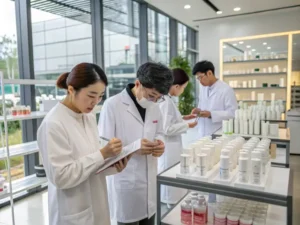
The Next Challenge for K-Beauty, ‘Cosmetic Safety’ and Prepared ‘Documentation’
In the rapidly changing K-Beauty market, beyond innovative efficacy and beauty, the fundamental value of ‘cosmetic safety‘ is emerging as the core competitiveness that determines the survival and growth of companies. Especially with the upcoming implementation of a new safety evaluation system in 2028, how systematically companies are equipped with data and documented records will be a critical test bed for success in the future market.
Essence of Cosmetic Safety and Role of Toxicology
To delve deeply into the importance of cosmetic safety evaluation, we met with Professor Kim Gyu-bong from Dankook University’s College of Pharmacy and Director of the Human Risk Assessment Research Center. Professor Kim graduated from Sungkyunkwan University’s Department of Pharmacy and worked on drug licensing and safety evaluations at Yungjin Pharmaceutical’s Central Research Laboratory and the Ministry of Food and Drug Safety. He later received a Ph.D. in Toxicology from the University of Georgia, USA, and is currently active in education, research, and regulatory consultancy as the Dean of Dankook University’s College of Pharmacy.
Professor Kim emphasized the essence of cosmetic safety as follows:
“Cosmetic safety must be prepared before problems arise. With data, there are solutions, but without it, difficulties ensue. Safety isn’t a ‘declaration’ but a ‘provable record.’ As markets go global and AI starts to read and judge documents, the weight of documentation grows. People expect ‘effects’ from cosmetics. It’s interesting to hear claims about wrinkles smoothing out and skin improving. Toxicology stands at the opposite end, stating ‘this might not be good’ and ‘you need to be careful.’ It’s an uncomfortable but necessary discussion.”
Although Professor Kim describes toxicology as a ‘boring discipline,’ he affirmed its crucial role in the cosmetics industry. Toxicology is part of the larger frame of ‘safety,’ dealing with issues like allergies, discomfort, and inflammation. However, in the field of cosmetics, terms like ‘toxic’ or ‘hazardous’ can easily lead to misunderstandings, hence ‘safety’ is the preferred term. What’s important isn’t the terminology but the scientific assessment and evidence it represents. Toxicology is about establishing a system where products are marketed based on a thorough, scientifically justified process, documented and ready to address potential issues, rather than guaranteeing perfect safety.
Scientific Data and Documentation-Based Risk Assessment
Toxicology starts on the premise that all substances can be potential toxicants based on ‘how much’ and ‘under what conditions’ they are used. Just as excessive consumption of water or coffee can cause problems, cosmetics are no exception. Particularly for products like sunscreens, where usage amount and frequency vary, evaluating safety based on absorption changes is even more essential. Merely stating “this ingredient is safe” isn’t enough; it’s important to differentiate and assess the inherent toxic types such as skin penetration at specific concentrations, liver toxicity, reproductive toxicity, endocrine effects, etc. Unlike drugs, which accept side effects to treat diseases, cosmetics, intended for beauty, require a much stricter range of toxic tolerance.
While it’s perceived that most cosmetics pose little risk, if a single individual among millions of users experiences a problem, it becomes 100% problematic for that individual. Toxicology plays the role of explaining and managing this gap between individual concern and overall statistics. With advancements in skin penetration technologies like microneedles and nano-carriers, safety issues alongside efficacy are increasing. When absorption-enhancing delivery technologies are applied, companies must conduct their own risk assessments, a responsibility only the individual company can fulfill. Previously, the approach was “this substance is problematic,” but now it’s about asking “if it must be used, up to what point is it safe?” Risk assessment involves using data to calculate daily dosage, exposure, and safety margins, articulating these through figures. Ultimately, toxicological risk assessment presents evidence through experiments and figures, documenting this accumulated data in the form of a Product Information File (PIF). It must be explainable that “a reasonable scientific procedure was followed for evaluation, and evidence is possessed” when issues arise.
Skin Toxicity Tests and OECD Alternative Test Methods Utilization
The core criteria in evaluating the skin safety of cosmetic products include skin irritation, skin corrosivity, skin sensitization, phototoxicity, and photoallergenicity. Skin irritation refers to the phenomenon where chemicals temporarily damage the skin epidermis causing inflammatory reactions, while skin corrosivity denotes the irreversible destruction of skin tissues by substances. Skin sensitization is an immune response where substances provoke allergic dermatitis upon repeated skin application. Phototoxicity and photoallergenicity occur when substances cause skin harm or immune responses when used along with ultraviolet rays.
Instead of animal testing, the OECD TG (Test Guideline) alternative test methods utilizing human-derived 3D skin models are commonly used. For skin irritation tests, OECD TG 439 In vitro skin irritation tests (Reconstructed Human Epidermis, RHE model) utilize artificial skins like EpiDerm, SkinEthic, EPISKIN. The representative skin corrosivity test method is OECD TG 431 In vitro skin corrosivity test (RHE-based). For skin sensitization tests, OECD TG 442C Direct Peptide Reactivity Assay (DPRA), OECD TG 442D KeratinoSens, OECD TG 442E Human Cell Line Activation Test (h-CLAT), and for phototoxicity, the OECD TG 432 3T3 Neutral Red Uptake (NRU) Phototoxicity Test are primarily used. Ocular irritation tests use OECD TG 437 Bovine Corneal Opacity and Permeability (BCOP) Test and OECD TG 438 Isolated Chicken Eye (ICE) test methods using bovine and chicken eyes respectively.
Managing Safety of Microplastics, Nanomaterials, Complex Formulations
Microplastics and nanomaterials differ from simple chemicals as they are physical particles, thus requiring a different toxicological approach. Their risks can vary greatly depending on size, surface characteristics, agglomeration, and material composition. Nanomaterials, in particular, can penetrate deep through damaged skin or hair follicles, with possible accumulation from long-term use. Regulations such as mandatory nano-material labeling and microplastic use restrictions are being tightened in Europe, signaling the need to consider long-term consumer and environmental safety.
Challenges in toxic evaluation of microplastics and nanomaterials arise from unclear definitions and classifications. Microplastics are defined as solid polymer materials under 5mm, but their harmfulness varies greatly based on shape, density, and biodegradability. Nanomaterials typically refer to particle sizes between 1-100nm, though surface features and aggregation conditions critically determine actual toxicity. Being particulate, they carry physical risks, and nanomaterials, in particular, can disrupt cellular functions or cause oxidative stress through cell penetration. Microplastics may induce local inflammation or skin barrier damage, with secondary toxicity arising from exuded additives or absorbed external pollutants.
While complex formulations like emulsions, liposomes, and nanoemulsions maximize efficacy and sensory characteristics, their complex physicochemical structures and interactions make it challenging to predict safety using existing toxic evaluation systems. Given that delivery systems can alter behavior in bio-systems based on their size, structure, and surface characteristics, assessing and managing unforeseen toxic reactions is essential. Current safety evaluations prefer complete product units, considering overall physicochemical properties and bio-interactions. Notably, the EU cosmetics regulations (EC No. 1223/2009) require structural characteristics of formulations and impact of delivery systems to be included in Cosmetic Product Safety Reports (CPSR).
Addressing Extraction Ingredient Side Effects and AI Utilization
Evaluating the safety of extract-based ingredients is relatively difficult due to their complex composition. It is crucial to identify the main components within the extract, calculate their presence throughout the extract and final product, and conduct risk assessments per component. Even for ingredients with a traditional usage history, scientific safety evaluation accommodating current usage conditions, concentration, and exposure patterns is necessary.
When adverse reactions or complaints arise from cosmetic use, a scientific reevaluation of the product’s overall safety from a toxicological perspective is required. Detailed data on the adverse event (product information, usage duration and frequency, symptom types, exposure sites, concurrent product usage, allergy/skin disease history, etc.) should be collected for toxicology analysis. Furthermore, manufacturers must check batch quality and physicochemical properties (appearance, pH, viscosity, color, preservative levels, active ingredient quantification, microbial contamination, etc.) to determine if manufacturing issues might be the cause. Consulting specialists, reviewing evaluation materials from domestic and foreign institutions, chemical registration info, scientific journal databases, and conducting QSAR-based predictions or in vitro toxicology tests as needed are essential for risk assessments.
While AI can assist in predicting safety evaluations, it doesn’t create accountable data. Actual experimentation and evaluation remain critical. Nonetheless, AI can be supplementary in literature research or initial structure comparison stages to improve efficiency. Securing reliable real-world data is paramount.

2028 Regulatory Changes and Global Market Response Strategies
Larger domestic companies are relatively well-prepared for cosmetic safety evaluations, but SMEs remain vulnerable. Without safety data after successful sales, companies face substantial risks. From 2028 onwards, a minimum safety evidence requirement will be mandatory regardless of company size. Global companies are internally accumulating safety data even if they don’t disclose raw ingredients. This preparation is crucial for responding scientifically to potential issues. Expecting sales in the hundreds of millions or billions without investing tens of millions in safety assessment is unconvincing, leading to a risk of relying solely on marketing in a market of similar products. Not all ingredients require the same evaluation level—cost burdens reduce by focusing on 1-2 key ingredients.
Widely used cosmetic ingredients are continuously managed at a national level, imposing use restrictions or adjusting permissible concentrations when safety concerns are identified. Conversely, proprietary materials or ingredients developed by companies fall entirely on their responsibility. Companies must secure and document safety data for such developments. Unlike pharmaceuticals, the cosmetics field lacks a fully established consulting infrastructure for these assessments. While the Korea Institute of Industrial Technology has built basic ingredient safety data, companies must directly prepare data for proprietary ingredients.
In the accelerating globalization of K-Beauty, particularly in markets with high litigation risks like the US, defending issues that arise without documented safety evaluations becomes challenging. While the 2028 horizon might appear distant, the accumulation and exposure of currently marketed products could become issues. Problems arising before system implementation remain impactful. Global issues can arise from previously domestic-only matters due to export expansion. Companies need to perform and document individual safety evaluations specific to each formulation, something beyond the jurisdiction of national authorities like the Food and Drug Administration.
Future of Professional Training and AI Utilization
There is still insufficient expertise and system for cosmetic safety evaluation in the country. Although some universities and research teams conduct projects, reliable places are limited. The year 2028 is approaching faster than anticipated, necessitating systematically accumulated knowledge and experience from the undergraduate level. As discussions on qualification systems unfold, granting credentials means assigning accountability. It isn’t desirable to rely on superficial knowledge or formal certifications alone. In Europe, alongside master’s degrees in chemistry or biology, focused education is essential.
The Ministry of Food and Drug Safety has been refining the system since 2014 through the ‘Advanced Cosmetics Risk Assessment Project.’ The year 2028 represents a point where the approximately 15-year-old corporate autonomy grace period following the 2011-2013 switch to negative regulation under the Cosmetics Act ends, and clearer requirements for safety data possession and documentation emerge. Functional cosmetics will start in 2028, expanding in phases until 2031, with micro-businesses (under 1 billion won annual revenue) adopting by 2032. Companies need to prepare for three things now: accurately identifying ingredients, roles, purposes, and application concentrations; systematically organizing existing literature and safety information; and documenting safety evidence through risk assessments if necessary. The year 2028 might not be a start point but a time when readiness should already be in place.
Cosmetic researchers must clearly recognize the toxicological risks and the necessity for safety evaluations of ingredients and formulations. Cosmetic safety isn’t just a matter for certain experts but a domain for collective consideration from the research and development stages. Researchers, with diverse majors and areas of responsibility, can’t fully master every toxicological detail. However, especially when conducting material-centric research, escaping safety issues related to ingredient exposure, penetration potential, and long-term use is challenging. Recognizing these safety issues as essential elements of research is necessary. Understanding safety not only avoids limiting research but also forms the foundation for increasing the reliability and sustainability of cosmetic products.
Conclusion
In the cosmetics industry, toxicology doesn’t promise perfect safety; it demands thorough preparation. The core is evaluating products through reasonable scientific procedures, documenting these processes, and establishing systems. Cosmetic safety will now become a crucial element for sustainable growth, where creating safely and responsibly-crafted products becomes essential. Building reliable safety data for company use is the most realistic role toxicology can contribute to the cosmetics industry.
Securing cosmetic safety for the future of K-Beauty starts with reliable data and systematic documentation. will deliver such crucial industry information in depth, providing practical assistance for your informed decision-making.