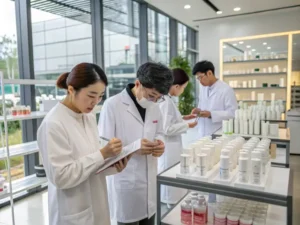
‘Mandatory Cosmetic Safety Evaluation’, An Unavoidable International Trend
In 2024, the export volume of cosmetics is set to surpass 10 billion dollars, marking a brilliant achievement for K-Beauty in the global market. However, behind this growth lies a new challenge: the strengthened cosmetic regulations in various countries abroad. It is now crucial for the domestic cosmetics industry to align with these international trends by enhancing safety measures to secure sustainable competitiveness.
Amendment of Domestic Cosmetics Law and Introduction of New System
The partial amendment to the cosmetics law, announced on December 30, 2025, heralds significant changes for the domestic cosmetics industry. The core of the amendment requires that cosmetic sellers compile and retain safety evaluation data for each product before distribution and sale and mandates a review by a ‘Safety Evaluator’ with relevant qualifications or experience. This aims to ensure consumer safety and strengthen the industry’s voluntary quality responsibility. Additionally, a proposed Cosmetics Safety Information Center will be dedicated to providing technical support and ingredient safety information for cosmetic safety evaluations.
The Minister of Food and Drug Safety can demand the submission of safety evaluation data from cosmetic sellers if deemed necessary for public health reasons. This new system not only strengthens regulations but also serves as a foundation for enhancing the quality credibility of the domestic cosmetics industry, solidifying its position in the global market.
Step-by-Step Implementation Roadmap and Global Trends
The safety evaluation system under the revised cosmetics law will be implemented gradually, starting with functional cosmetics on January 1, 2028. The application timeline may vary by company size, but from January 1, 2031, it will be expanded to all cosmetic items. This safety evaluation is already widely established internationally.
Europe has been applying the Cosmetic Product Safety Report (CPSR) since the mid-2000s, and China prepared and implemented a related system from early 2020. The U.S. has also strengthened regulations through the Cosmetic Modernization Act, making safety evaluations mandatory by 2028. Japan has operated a complete voluntary responsibility system since the 2000s, essentially conducting safety evaluations.
Special Regulatory Barriers in the Chinese Market
South Korea’s heightened focus on cosmetic safety evaluations began notably when China introduced its system in early 2020. While most countries use safety evaluations as post-market regulations, China implements pre-sale regulations requiring submission of safety evaluation data to the government at the time of production or import. This stringent regulation posed a significant barrier for domestic products entering the Chinese market.
China enforces pre-sale regulations requiring the submission and approval of safety evaluation data to the government for production and import.
Previously, the reason domestic cosmetics companies paid little attention to safety evaluations when exporting to the U.S., Europe, and Japan was that these countries applied safety evaluations as post-market controls, not directly affecting product launches. In some cases, companies avoided issues by discontinuing products despite poor safety evaluation data. However, large companies are known to have been preparing and responding to their own safety evaluations for exports to the U.S. and Europe even before safety evaluation issues became prominent domestically.
Corporate Voluntary Responsibility and Consumer Protection
The essence of the cosmetic safety evaluation system is that companies themselves decide, based on scientific knowledge and methods, whether a developed and sold cosmetic poses no potential harm to consumers, and that they document the basis for this decision. Legally set safety standards are minimal safeguards, and it is challenging to fully assure safety only through safety evaluations of newly introduced cosmetic ingredients and distribution standards.
The policy’s intention is for the developers and manufacturers, who can best assess a product’s safety, to comprehensively evaluate the product.
Therefore, through this process, if a company’s product passes the safety evaluation, it can record this and release the product. This represents the most proactive regulation to protect consumers and is a necessary step for K-Beauty to build continuous trust in the global market.
Key Tasks for a Sustainable K-Beauty
Mandating cosmetic safety evaluations is a crucial process for K-Beauty to ascend as a global leader. Beyond mere regulatory compliance, it offers companies an important opportunity to affirm the safety of their products and openly disclose this information to consumers to build trust. We anticipate that under strengthened standards, safer and more innovative K-Beauty products will continue to lead the global market.
Now, cosmetic safety evaluation is not a choice but a crucial competency for K-Beauty. is committed to providing practical support to help companies successfully adapt to these changes and lead the global market with trusted products.