Reshaping the Export Infrastructure for K-Beauty: From Purchase Environment to Logistics and Certification
The global popularity of K-Beauty continues to rise, prompting the government to unveil a comprehensive plan to revamp the export infrastructure. To achieve the ambitious $70 billion export target by 2030, support will be provided across various aspects, including distribution networks, logistics systems, and certification processes.
Focusing on Cosmetics within the 5 Promising Consumer Goods, Accelerating Global Market Expansion
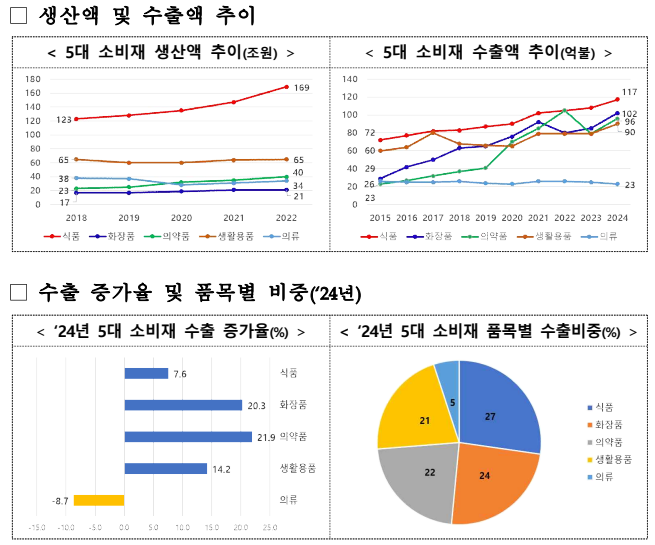
On December 24, 2025, the government announced the ‘Plan to Expand Exports of K-Consumer Goods’, designating cosmetics alongside food, pharmaceuticals, daily necessities, and clothing as the five promising export categories. They aim to establish tailored support systems suited to each industry’s characteristics.
K-Beauty, in particular, exhibited significant growth with cumulative exports reaching $10.4 billion from January to November. This is a more than twofold increase compared to the $21 billion total consumer goods exports in 2015, marking a pivotal moment for the industry.
"There is significant demand for K-Beauty products worldwide, but the purchasing process is overly cumbersome," is a common sentiment among foreign consumers.
Responding to this feedback, the government is focusing on alleviating the worldwide consumers’ challenges associated with unfamiliar and complicated purchasing environments, emphasizing that the technical capabilities are sufficient.
Activating Global Reverse Shopping Platforms and Also Pursuing Localization Strategies
The first area of change will be the purchasing process. By 2026, the government plans to establish around five global online malls to facilitate easy purchases of Korean beauty products for international consumers. Support for multilingual content translation, mobile app development, and operational costs for service centers will lower shopping barriers.
Measures have also been included for small brands that lack their own online malls. A system that integrates payment and shipping via a reverse shopping proxy platform will be set up, connecting to major overseas payment methods like PayPal and Apple Pay.
Foreign marketing strategies will shift to experiential modes. Starting February 2026, a ‘Foreign Reverse Shopping Customer Experience Group’ will operate in five countries, including the USA and Japan, to diagnose difficulties from the local consumer perspective, aiming to improve infrastructure quality through service enhancement insights from the entire process including inflow, payment, and customs clearance.
"It is essential to incorporate actual consumer feedback into structural improvements beyond simple promotions," an official stated.

Establishing a Logistics Center in LA, Shifting the Weight of Cosmetics Exports
An eye-catching shift in the new strategy is the overhaul of the logistics system. Due to the unique nature of cosmetics, including expiry and quality maintenance, simple warehouse shipping systems are insufficient to earn global consumer trust.
Recognizing this, the government will establish a dedicated cosmetics logistics center for small businesses in Los Angeles, USA, by 2026. This center will be equipped with a cold chain that allows for refrigerated distribution and fulfillment. Covering all distribution phases, including returns, repackaging, and quality control, represents a fundamentally different approach.
A representative from a distribution company noted the following:
"Cosmetics are sensitive to temperature, and mainstream warehouses have limitations. Specialized logistics centers are crucial for building credibility with global customers."
The plan also includes establishing joint shipping systems with major distribution networks to reduce logistics costs for small businesses. In fact, logistics fee support limits using export vouchers will expand from 30 million to 60 million won.
Simplifying Complex Foreign Certification Procedures with AI-based Solutions
One of the recurring challenges K-Beauty companies face in the export field is the varied certification systems and labeling standards across countries. With differences in permissible ingredients and labeling requirements, these technical regulations act as barriers, especially for small brands.
To address this, the government will introduce a ‘Consumer Goods Labeling Support’ service and provide up to one million won per case through export vouchers. This approach is expected to effectively reduce administrative costs for small brands.
Additionally, a more foundational solution is being pursued. By the first half of 2026, an AI-based ‘Integrated Information System for Overseas Certification-Technical Regulation’ will be operational, centralizing regulatory information by country. The National Standards Agency will also run a ‘Dedicated Support Team for Consumer Goods Certification’ to offer specific consultation on appropriate certification strategies for each brand.
"There are high expectations that new pathways will open in markets previously restricted by unfamiliar item regulations or labeling requirements."
K-Beauty Special Exhibition in Global Conventions, Focusing on ‘Skin-Tech’
The new measures emphasize that export expansion requires sophisticated R&D and packaging strategies beyond merely pushing products. To support this, the government will establish a ‘K-Beauty Special Exhibition’ at global beauty fairs like Cosmoprof and concurrently support skincare-based technology and bio-material-centered cosmetic R&D.
The level of digitalization and labeling of products is regarded as a critical factor in brand credibility, leading to the inclusion of packaging development support. The emphasis on such sophistication is seen as a decisive difference in determining export potential in rapidly evolving global markets where regulations and new technologies are closely intertwined.
Adding 10 Consumer Goods Logistics Desks, Enhancing Point-based Integrated Support Systems
The export infrastructure overhaul isn’t confined to a single industry. The government plans to establish 10 ‘K-Consumer Goods Logistics Desks’ at key bases in North America, Europe, and Asia, operating an integrated support system linking customs-clearance-certification-marketing.
Additionally, the current number of 302 overseas joint logistics centers will increase to 322 by 2026. Setting up these key-point networks is expected to distribute the field workload arising from both citizens and businesses.
This goes beyond a narrow focus on just “K-Beauty support” to a broader consumer goods export strategy, encompassing food, pharmaceuticals, fashion, and more. It represents a multi-layered approach reflecting the unique attributes of each industry as well as global environmental changes.
"Rather than just exporting popular products, we aim to expand the operational system itself to structure the export industry."
Conclusion
K-Beauty has established itself as a key strategic export product beyond mere trends through widespread infrastructure restructuring. If the government’s measures reflecting corporate voices are executed progressively, the presence of K-consumer goods in the global market is anticipated to become even more solidified.
` is a trustworthy partner in the growth and global market reach of K-Beauty, contributing to the enhancement of the global competitiveness of the cosmetic industry.
