Innovation Over Regulation: Professor Kim Joo-deok’s Farewell Message for the Future of the Cosmetic Industry
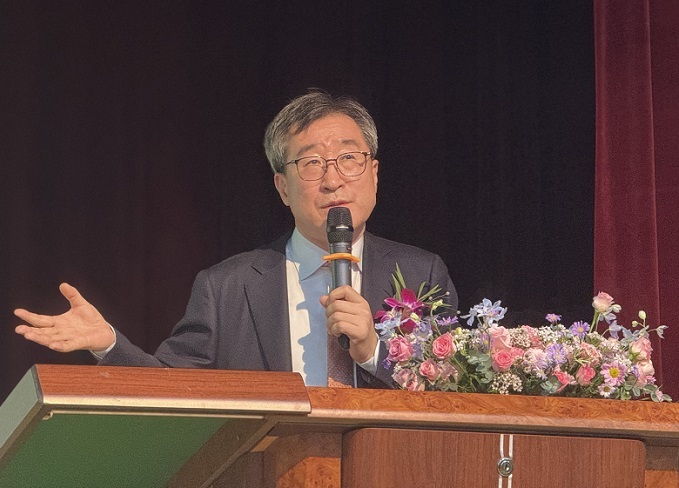
Dr. Kim Joo-deok, Dean of the Beauty Convergence Graduate School at Sungshin Women’s University, has retired. Beyond being just an educator, he stood at the forefront of policy direction, education, research, and talent development in the Korean cosmetics industry. At his retirement ceremony, he reiterated the need for “innovation over regulation” and presented the path the cosmetics industry should take.
37 Years That Changed the Flow of the Cosmetic Industry
The retirement ceremony for Professor Kim Joo-deok, held on December 12 at Sungshin Women’s University Unjeong Green Campus, was not just a farewell event, but a meaningful moment summarizing the past 37 years. His journey began in 1988 as a researcher at LG Household & Health Care, continued as a professor at Kyungbuk Science College in 1995, and later spanned Sookmyung Women’s University and Sungshin Women’s University, culminating in his role as Dean of the Beauty Convergence Graduate School.
During this period, Professor Kim went beyond mere academic research, impacting policy-making and site consulting, and fostering industry-academia collaboration, leaving a significant mark on the development of the cosmetics industry. A notable achievement was the advancement of the “Cosmetic Industry Comprehensive Development Plan” by three years to achieve the goal of “entering the G7 by 2020,” a testament to his foresight during his tenure as the head of the Cosmetics Industry Development Planning Team at the Ministry of Health and Welfare in 2017.
“At the time, the concept of a ‘national image industry’ was unfamiliar, but I dreamed of the day cosmetics could represent the nation, like in France.”
Three Policies for Innovation, Questioning the Direction of the Industry
In a farewell lecture themed ‘Regulatory Innovation for K-Beauty’s Global Leap,’ Professor Kim proposed three suggestions for the future of the industry.
The first was the revision of the functional cosmetics system. He emphasized that “functional cosmetics are actually hindering innovation, and it is time to shift from a notification-based system to efficacy-based derma cosmetics.” He explained that the uniform level of functionality has cemented Korean cosmetics in an image of low prices abroad, failing to differentiate itself.
The second was the classification of toothpaste as cosmetics. He argues that toothpaste, currently classified as a quasi-drug only in Korea, applying complex regulations, should instead be classified under ‘cosmetics’ like in Europe, the U.S., and China. This change could positively impact both the expansion of industry categories and the re-establishment of consumer perception.
“Europe considers teeth and oral mucosa within the category of cosmetics. It’s time for us to change that frame as well.”
Advertising Substantiation System, Expression Equals Competitiveness
The third proposal was the abolition of the advertising substantiation system. He criticized that the current advertising regulations are too detailed and strict, infringing on freedom of expression and stifling the distinction and creativity between brands.
The current system, “where omitting even a single word leads to administrative action,” is excessively restrictive compared to the expressiveness and persuasiveness shown in the global market. Professor Kim suggests there should be a shift to autonomy in regulations, supported by scientific data established by companies, and broadened consumer information accessibility in advertising.
“Without expression, there is no image, and ultimately no competitiveness. It’s time to use advertising as a policy weapon.”
Educator, Researcher, Policy Maker… ‘Eternal Active’ Retirement
Professor Kim Joo-deok’s retirement is not merely a conclusion of his career. His countless disciples remember him as an ‘intellectual root’ and ‘industry navigator,’ indicating his influence will continue.
At the retirement ceremony, he stated, “The time spent at the university was a continuous journey of learning, and I wish to contribute in other ways now.” Students remembered Professor Kim as “a bridge between industry and academia and more than a teacher,” with many institutions and groups sending messages of gratitude and support for his future.
It also became a focal point that ‘The Art of Cosmetics’ was selected for the 2025 Sejong Book Cultural Division. This book has been praised for demonstrating communication principles that link academia, industry, and consumers.
Time for ‘Continuous Innovation’ Over ‘One-off Success’
He did not forget to point out that while the industry’s appearance has grown, its substance is still lacking. He compared the current growth of indie brands to relentless price competition and endless replication of similar products, suggesting the need for fundamental structural improvements.
“It’s time for the government to shift to post-regulation. That’s the only way brands can grow healthily and the industry can last long.”
He especially designated cosmetics as a ‘national image industry,’ emphasizing that innovation is the basis of global branding strategy. In an era when AI, ESG, and personalized products are essential, he argues that existing guidelines are holding them back, and precise yet flexible policies are needed.
In Conclusion
Professor Kim Joo-deok’s retirement marks the end of an era but also serves as a compass pointing the way forward for the industry’s future direction. Now is the time for the cosmetics industry to prepare for a new leap through regulatory easing and evidence-based innovation.
will continue to strive for the development of the cosmetics industry and to provide innovative solutions. We look forward to your continued interest and support in advancing the field of cosmetics, and invite you to open a beautiful tomorrow with .
